The Mechanical Roots of Arcade Entertainment
Long before video screens and joysticks, arcades were physical spaces built around machines that rewarded curiosity and timing. These early devices set the foundation for public, pay-per-play entertainment, establishing habits and expectations that would later define electronic gaming. Although simple in structure, their importance actually lies in the factuality that they first introduced structured play into everyday public life.
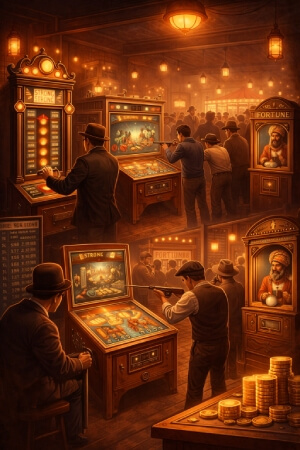
Coin-Operated Machines and Early Amusements
Discussing the possible origins of the arcade at the end of the 19th and in the early part of the 20th centuries, arcades filled with coin-operated devices designed for short-lived repetitive amusement. Before 1900, these would be objects like strength testers, fortune-telling machines, mechanical shooting ranges, and early pinball variants. Machines were simple yet effective: built all but intricately with immediate feedback and clear results. Put in a coin, perform an action, get a result. This that was the core logic behind arcade gaming for the next several decades.
It just seemed right that an idea like this would be placed in-between fairs, within train stations, on bar sides, on seaside walkways. Social circulation; mingling of a commuter spirit, lost times, and evident energies in the wait. By this time, folks were good to pay small amounts for a moment of entertainment. And it reinforced video arcades to develop quickly, since players accepted the concept of parting with coins on a favor.
Pinball and the Birth of Competitive Scoring
Pinball machines, especially those developed in the 1930s and 1940s, added a new dimension to arcade entertainment: skill-based scoring. Unlike purely chance-driven machines, pinball rewarded timing, control, and practice. The introduction of flippers transformed pinball from a passive game into an interactive challenge, allowing players to influence outcomes more directly.
Scoring systems and leaderboards encouraged repeat play. Players returned not just to pass time, but to beat their previous scores or outperform others. This competitive element shaped the social atmosphere of arcades. Even without digital displays, players compared results, shared techniques, and built informal reputations. The idea that a machine could measure skill and improvement would later become central to video game design.
Social Spaces Before Screens
Early arcades were less about technology and more about environment. They were noisy, crowded, and often informal spaces where people gathered without long-term commitment. Unlike theaters or sports events, arcades allowed people to come and go freely. This flexibility made them accessible across age groups and social classes.
These spaces also established behavioral norms. Waiting for a turn, watching others play, and learning through observation became part of arcade culture before video games existed. By the time electronic games arrived, the social framework was already in place. The machines changed, but the communal rhythm of play remained.
The Rise of Video Arcades in the 1970s and 1980s
The emergence of video technology largely turned arcades from quaint miracle boxes to majors in the realm of culture. The greatest triumph in the history of arcades increased gaming in spectacle, competitiveness, and global reach. The spread of video arcades brought rapid changes to both entertainment practice and game aesthetics.
The First Video Games Enter Public Spaces
In the early 1970s, video games moved out of research labs and into commercial venues. Early titles were simple by modern standards, but they captured attention through motion, light, and sound. For the first time, players interacted with moving images rather than physical components. This shift made games easier to update, replicate, and distribute.
Public interest grew quickly. Video games felt futuristic, offering experiences unavailable elsewhere. Arcades became showcases for emerging technology, drawing crowds eager to try something new. The machines were relatively compact, allowing operators to place many games in a single location. This density increased variety and competition among titles, encouraging rapid innovation.
The Golden Age of Arcades
The late 1970s and early 1980s are often described as the golden age of arcades. During this period, iconic games introduced recognizable characters, distinct visual styles, and increasingly complex mechanics. Arcades multiplied across cities, appearing in malls, standalone venues, and entertainment districts worldwide.
What defined this era was not just popularity, but intensity. Games were challenging by design, encouraging short play sessions and frequent restarts. Difficulty curves ensured a steady flow of coins while rewarding mastery. Players memorized patterns, developed strategies, and competed for high scores. Arcades became training grounds where skill, persistence, and observation mattered more than chance.
High Scores, Competition, and Community
High score tables turned individual play into public performance. Achieving a top score meant having one’s initials displayed for all to see, sometimes for weeks. This visibility created local legends and rivalries. Regular players recognized each other, shared tactics, and sometimes guarded secrets.
Arcades functioned as informal communities. They were places where friendships formed across age and background, united by shared goals and challenges. The physical presence of others shaped how games were experienced. Watching someone else succeed or fail was as much part of the entertainment as playing oneself. This collective energy distinguished arcade gaming from later home-based experiences.
Global Expansion and Cultural Influence
As video arcades spread internationally, they adapted to local tastes while maintaining a shared visual and mechanical language. This global expansion helped standardize gaming conventions and created a feedback loop between designers and players across continents. Arcades became both exporters and importers of cultural ideas.
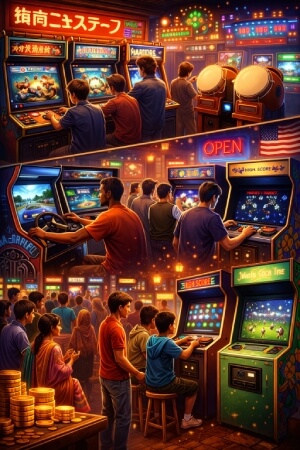
Regional Differences in Arcade Culture
While arcades appeared worldwide, their role and atmosphere varied by region. In some countries, arcades were youth-focused spaces, while in others they attracted a broader demographic. Layouts, game selections, and operating hours reflected local norms. Competitive fighting games, rhythm games, and multiplayer cabinets found especially strong followings in certain regions.
These differences influenced game development. Designers observed how players interacted with machines in different markets and adjusted mechanics accordingly. Control schemes, difficulty levels, and visual themes were often refined based on regional response. Arcades thus became testing grounds for global gaming preferences.
Influence on Game Design and Technology
Arcade hardware pushed technological boundaries. Developers prioritized smooth animation, responsive controls, and immediate feedback. Because arcade games had to impress quickly, visual clarity and intuitive mechanics were essential. These design principles later influenced console and computer games.
Arcades also accelerated innovation cycles. Successful concepts were quickly copied, refined, or challenged by competitors. This rapid evolution fostered creativity and experimentation. Many genres, including shooters, racing games, and fighting games, were defined and standardized in arcades before moving into homes.
Arcades in Popular Culture
Arcades left a lasting mark on popular culture. Their imagery, sounds, and characters appeared in films, music, fashion, and advertising. They symbolized modernity, youth, and technological excitement. For many, arcades became nostalgic symbols of a specific era, representing both technological optimism and social connection.
This cultural presence reinforced the idea of gaming as a shared activity rather than a solitary one. Even as technology evolved, the memory of crowded arcades and glowing screens continued to shape how people talked about games and gamers.
Decline, Reinvention, and Modern Arcades
The rise of online gaming focused on massive multiplayer online, which is dealing the last blow to local arcades. Home consoles marked how personal computers booted the earlier arcades out of offices, home spaces, and schools. Symbolically speaking, arcades imply a messy mix of urban lights and sounds. Online gaming and home console gaming established a new trend, by which that is what arcade gaming; dead! Arcades were a bloodied relic in the back alleys until the late '90s. With resourceful thinking and maneuvering, arcades rose to face the changing terrain of entertainment punching back into existence.
The Impact of Home Gaming Systems
By the late 1980s and 1990s, home gaming systems became more powerful and affordable. Players could enjoy longer, more complex experiences without leaving home. This convenience reduced the appeal of traditional arcades, especially those offering games similar to home titles.
Economic factors also played a role. Rising operational costs and changing real estate patterns made it harder to maintain large arcade spaces. Many venues closed, marking the end of an era. However, the decline was uneven. In some regions, arcades remained culturally relevant, especially where social gaming continued to be valued.
Adaptation Through Experience-Based Gaming
To survive, arcades shifted focus from standard games to experiences difficult to replicate at home. This included large-scale cabinets, motion-based systems, rhythm games, and multiplayer setups requiring physical presence. The emphasis moved from individual skill to shared experience.
Modern arcades often combine gaming with food, music, and social events. They position themselves as entertainment destinations rather than pure gaming venues. This evolution reflects a return to the arcade’s original strength: creating spaces where people gather around play.
Nostalgia and the Arcade Revival
In recent years, nostalgia has fueled renewed interest in classic arcade games. Retro arcades, barcades, and pop-up events celebrate the aesthetics and mechanics of earlier eras. These spaces attract both longtime fans and younger audiences curious about gaming’s roots.
This revival is not about replacing modern gaming but complementing it. Arcades now serve as cultural memory spaces, preserving the history of public play while adapting to contemporary tastes. Their continued presence highlights the enduring appeal of shared, physical gaming environments.
The Economics Behind Arcade Success
Before reaching their cultural peak, arcades had to function as viable businesses, and their economic structure played a major role in shaping game design and player behavior. Revenue depended on high turnover rather than long play sessions. Games were deliberately built to be challenging, encouraging frequent coin insertion while keeping individual sessions short. This balance between frustration and reward was carefully tuned, turning difficulty into a commercial tool rather than a purely creative choice.
Operators also curated game lineups strategically. Popular machines were placed in visible, high-traffic areas, while newer or experimental titles rotated in and out to test demand. Maintenance, reliability, and durability mattered as much as creativity, since downtime directly affected earnings. These economic pressures influenced everything from cabinet design to sound levels. Understanding this business logic helps explain why arcade games felt intense, immediate, and demanding, and why that design philosophy continues to influence game development today.
Why Arcades Still Matter
More interesting than machines, however, were the stopwatch competitions with camaraderie for playing and being together more than anything else-lending a different structure to the high-interaction game worlds-the arcade variety. These would include mechanical amusement to digital shows, defining design and culture and social practices for multiple generations. Today, with a huge metamorphosis in fast-moving flash animation, the arcade sees that sharing is really the best way of recreation.
🕹 Arcade Game of the Day 🕹
— Nostalgic Gamer (@16bitnostalgia) December 22, 2025
Arkanoid • 1986 • Taito pic.twitter.com/5QEasPiRAZ