The Origins of Arcade Games
The birth of arcade games was something of a slow and evolving process. They were begotten by mechanical amusements and early computer experiments, which in turn were born of societies' changing perspectives on machines. The very early popularity of these machines was pegged on necessity - the electronic-entertainment market, hitting a high tide exactly as its host venues were in desperate need of innovation to draw the customers in.
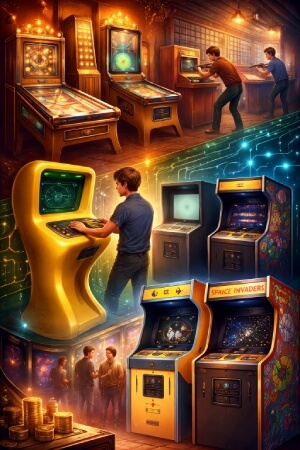
From Mechanical Amusements to Digital Screens
Before video arcade games existed, public entertainment relied on mechanical systems. Pinball machines, strength testers, shooting galleries, and electro-mechanical games dominated amusement halls. These machines taught operators that people were willing to pay small amounts for short, repeatable experiences. This model later became central to arcade gaming.
As computing components became smaller and more affordable in the late 1960s and early 1970s, developers began experimenting with interactive electronic displays. Early games replaced physical motion with visual feedback on screens. The shift was gradual, but it marked a turning point. Players no longer interacted with springs or levers alone; they responded to moving images, sounds, and rules generated by circuitry rather than mechanics.
The First Video Arcade Experiments
One of the earliest breakthroughs came with simple games that used basic visuals and straightforward rules. Titles like Computer Space demonstrated that people were curious about screen-based play, even if the controls and concepts were unfamiliar. These early machines were not universally successful, but they proved the concept.
The real turning point arrived when developers learned to balance simplicity with challenge. Games needed to be understandable within seconds, yet difficult enough to encourage repeated play. This balance defined the arcade formula. Players could not save progress or adjust difficulty; mastery came only through practice and persistence.
The Coin-Operated Business Model
The coin-operated structure shaped arcade game design in fundamental ways. Each play needed to feel worth the cost while leaving players eager for another attempt. This led to short game loops, escalating difficulty, and score-based rewards. High scores became a form of public recognition, turning performance into social currency.
Operators also influenced design choices. Machines had to be durable, visually appealing, and reliable under constant use. Bright cabinets, distinctive sounds, and eye-catching artwork were not decoration; they were essential tools for attracting attention in crowded spaces. This commercial reality pushed arcade games to be bold, immediate, and memorable.
The Golden Age of Arcades
Often called the golden years of arcade gaming, the late 1970s and early 1980s publicized the emergence of arcades within their own cultural canvas with video games entering mainstream attention. The potency of such innovations and creativity still allows identification of a variety of video games today.
This point in history did not involve but a single genre or audience, but rather arcade spaces allowed people of various backgrounds and ages to engage with each other in a competitive space characterised by the elements of competition, regard, and emulation. Success was never a silent thing in those moments, as it was vividly in your face.
Breakout Hits and Cultural Icons
Several arcade games from this era achieved global recognition. Pac-Man stood out for its character-driven design and broad appeal, attracting players who had not previously engaged with video games. Its success showed that arcade games could be approachable without losing depth.
Other titles focused on reflexes and precision. Space Invaders introduced persistent enemies and escalating pressure, while Donkey Kong added narrative elements and recognizable characters. These games established design patterns that continue to influence modern titles, from enemy waves to character progression.
The Rise of Competitive Play
Arcades naturally encouraged competition. High score tables displayed achievements publicly, turning individual play into a social performance. Players gathered around machines, watching skilled competitors and learning strategies by observation. This environment fostered informal mentorship and rivalry.
Competitive play also extended beyond local arcades. Magazines and record-keeping organizations began tracking high scores nationally and internationally. For some players, arcade gaming became a serious pursuit, requiring discipline, memorization, and physical endurance. The idea that video games could reward mastery, not just luck, gained legitimacy during this period.
Arcades as Social Spaces
Beyond the games themselves, arcades functioned as social hubs. They were places to meet friends, spend time after school, or escape daily routines. The layout encouraged interaction, whether through cooperative games, turn-taking, or shared spectatorship.
This social dimension distinguished arcades from later forms of solitary gaming. Players were rarely alone. Sounds overlapped, screens competed for attention, and reactions were immediate and visible. The arcade experience was as much about being seen as playing well as it was about winning or losing.
Game Design Principles Shaped by Arcades
The first and essential reason for accepting the game principles is the strict technical-commercial limitations on arcade games during that period which had set the philosophy for their development. Developers, beneath technical constraints, aimed to deliver quickly-appreciable experiences. So, the principles governing the genesis of game design arose out of these conditions.
This is why those very principles continue to permeate through games of today regardless of our more advanced hardware throughput that has ruptured the original constraints.

Simple Controls, Deep Mastery
Most arcade games relied on minimal controls, often a joystick and one or two buttons. This simplicity allowed anyone to start playing immediately. However, mastery required precise timing, pattern recognition, and strategic decision-making.
This contrast between easy entry and high skill ceilings became a hallmark of good game design. Players could improve gradually, learning from mistakes and refining techniques. Modern genres like fighting games and rhythm games still rely on this balance, tracing their roots to arcade conventions.
Difficulty Curves and Player Pressure
Arcade games were designed to become progressively harder. Difficulty increased through faster enemies, denser obstacles, or reduced reaction windows. This escalation served two purposes: it challenged skilled players and ensured that games eventually ended, encouraging continued spending.
The pressure created by rising difficulty also shaped emotional engagement. Success felt earned, while failure felt immediate and personal. Players learned to manage stress and maintain focus, experiences that many modern competitive games deliberately recreate.
Visual Clarity and Feedback
In crowded arcades, games had to communicate information instantly. Visual clarity was essential. Characters, enemies, and hazards needed to be distinguishable at a glance. Sound effects reinforced actions, providing feedback without requiring players to look away from the screen.
This emphasis on clarity influenced interface design across the industry. Health indicators, score displays, and audio cues became standardized. Even today, good game design prioritizes readable visuals and responsive feedback, principles refined during the arcade era.
The Decline and Transformation of Arcades
By the late 1980s and 1990s, traditional arcades began to decline in many regions. Home consoles grew more powerful, and players gained access to longer, more complex experiences without leaving home. However, arcades did not disappear overnight; they adapted and changed.
The shift was uneven, shaped by regional preferences, economic conditions, and evolving player expectations. While some arcades closed, others reinvented themselves around new types of experiences.
The Rise of Home Gaming Systems
Advances in home console technology reduced the technical gap between arcade machines and living room devices. Players could enjoy visually impressive games without paying per play. This convenience challenged the arcade business model directly.
At the same time, home gaming introduced new design priorities. Longer narratives, save systems, and personal progression became possible. These features were difficult to replicate in arcades, where short sessions and rapid turnover remained essential.
Arcades Shift Toward Experience-Based Play
To stay relevant, many arcades emphasized experiences that could not be replicated at home. Large cabinets, specialized controllers, and motion-based systems became more common. Rhythm games, racing simulators, and light-gun shooters offered physical engagement beyond standard controllers.
This shift reframed arcades as destinations rather than routine hangouts. Players visited for specific attractions or group outings, not daily practice. The focus moved from mastery to spectacle and shared novelty.
Regional Differences in Arcade Survival
While arcades declined in some regions, they remained strong in others. In parts of Asia, especially Japan, arcades continued to evolve as competitive and social spaces. Dense urban environments and strong public gaming cultures supported their survival.
These regional differences preserved arcade traditions that later influenced global gaming trends. Competitive fighting games, rhythm games, and score-based challenges thrived in arcade-rich environments and later spread through international tournaments and online communities.
Arcade Games and Modern Gaming Culture
Even as traditional arcades became less common, their influence never disappeared. Modern gaming culture continues to reflect arcade values in both design and community behavior. From esports to mobile games, arcade logic remains embedded in how games are structured and played.
Recognizing this influence helps explain why certain mechanics feel familiar, even in entirely new technological contexts.

The Legacy of Score and Skill-Based Play
Many modern games still prioritize skill-based performance, visible rankings, and competitive ladders. Leaderboards, time trials, and performance metrics echo the high score tables of arcades. Players measure success not only by completion but by comparison.
This focus supports ongoing engagement. As in arcades, improvement becomes a personal journey. The satisfaction of climbing rankings or refining execution mirrors the appeal that once drew players back to coin-operated machines.
Arcade Design in Mobile and Casual Games
Mobile games often rely on short sessions, simple controls, and escalating difficulty. These traits align closely with arcade design principles. While monetization models differ, the core experience of quick engagement and repeated attempts remains similar.
Casual games also adopt arcade pacing to fit modern lifestyles. Players can engage briefly, learn quickly, and stop without penalty. This accessibility reflects lessons learned decades earlier in public gaming spaces.
Community, Spectatorship, and Esports
Modern esports culture shares unexpected similarities with arcade environments. Competitive matches attract spectators, skilled players become local heroes, and performance unfolds in public view. Streaming platforms replicate the social dynamics once found around arcade cabinets.
This continuity highlights how arcades shaped not just games, but how people gather around them. The desire to watch, learn, and celebrate skill remains constant, even as the venues change.
Why Arcade Games Still Matter
Arcade games are more than historical artifacts. They represent a foundational chapter in interactive entertainment, defining how games are designed, played, and shared. Their influence extends beyond specific titles or machines, shaping expectations about challenge, fairness, and reward.
To understand modern gaming fully, it is necessary to understand the arcade mindset. Many contemporary debates about difficulty, accessibility, and monetization trace back to questions first addressed in coin-operated spaces.
Lessons in Design Discipline
Arcade developers worked under strict limits, forcing creativity through constraint. These limits encouraged efficiency, clarity, and focus. Modern developers, even with vast resources, often revisit arcade principles to avoid unnecessary complexity.
This discipline remains relevant. Games that communicate clearly, respect player skill, and offer meaningful challenge tend to endure, regardless of platform.
Shared Experiences in a Digital World
In an era dominated by online interaction, arcades remind us of the value of physical, shared spaces. The immediacy of face-to-face competition and cooperation created memories that extended beyond the screen.
While technology has changed, the human desire for shared play persists. Arcades offer a blueprint for designing experiences that bring people together, not just connect them remotely.
From Coin Slots to Cultural Cornerstones
Arcade games started as this, simple, coin-operated experiment-yet they turned out to transform entertainment all over the world. They fostered some basic design foundations, social interaction, and structures of competition which continue to influence modern gaming now. Even though clubhouse-based establishments might not be common nowadays, the spirit of an arcade remains in the new realm of console games, in the frenzy of mobile devices, and online arenas. Study arcade video games, and you will learn about where gaming acquired its fundamentals on how to interact, play, and captivate players in a shared practical space.