Arcades as Hubs of Shared Experience
Back then, home gaming consoles were nowhere to be seen, and digital games were available only in the arcades. And so, they became centers of solid human interactions. The thing with arcades was that one could run into someone and go social quickly. One didn't come just to play; he or she came to observe others doing kung fu, to learn from watching others playing Contra and Super Mario, and to covet if good enough to be noticed. Many times, nobody paid attention to the need for monetary inputs even. They simply stood by and observed the effectiveness of that strategy, the proficiency in fighting, endurance and dexterity of a player.

Public Play and Shared Attention
Arcade games were designed to be watched as much as played. Large cabinets, loud sound effects, and bright visuals pulled attention from across the room. This created a culture where spectatorship mattered. A skilled player was not hidden behind a screen at home but performing in front of others, often under pressure.
This public nature shaped behavior. Players learned to manage nerves, respond to commentary, and accept both admiration and criticism. Success was visible, and failure was public too. Over time, this helped arcades develop unwritten rules around respect, turn-taking, and acknowledging skill, reinforcing their role as social environments rather than anonymous venues.
Learning Through Observation
In arcades, knowledge moved socially. New players learned by watching experts handle difficult levels or complex controls. There were no tutorials or patch notes posted on walls. Instead, understanding spread through imitation, conversation, and trial and error.
This created informal hierarchies based on experience rather than age or background. A teenager could teach an adult. A quiet regular could become locally famous for mastering a specific cabinet. These dynamics gave arcades a sense of community identity built on shared learning rather than formal instruction.
Competition Without Isolation
Although many arcade games focused on competition, that competition rarely felt isolating. High score tables, head-to-head cabinets, and rotating challengers kept players connected. Even single-player games encouraged comparison, as initials on scoreboards told stories about who had been there before.
This form of competition emphasized presence. Winning meant something because others saw it happen. Losing felt lighter because another chance was always nearby, often encouraged by onlookers. Arcades balanced rivalry with camaraderie in ways that shaped how early gaming communities understood sportsmanship.
Arcades and Youth Culture
For countless number of young people, one of the perks of experiencing semi-independence was when they used to frequent arcades. They were allowed to have this freedom within a boundary, where time would pivot with few coins and not hours. The youngest time felt belonged, right when arcade culture & aesthetics that informed a desire for free play in the realm of teen identity, fashion, music and social behavior.
A Place Between Supervision and Freedom
Arcades occupied a unique middle ground. They were public enough to feel safe but informal enough to feel independent. Young people could gather without strict oversight while still being part of a shared environment. This balance allowed friendships to form organically.
Because of this, arcades often became after-school hubs. Players met regularly, developed routines, and built relationships that extended beyond games. These patterns mirrored other youth-centered spaces, but arcades added a shared focus that made interaction easier, especially for those less comfortable with traditional social settings.
Style, Music, and Identity
Arcades absorbed and reflected trends from the outside world. Clothing styles, slang, and music filtered in through players and machines alike. Cabinets blared soundtracks that blended electronic music with pop influences, shaping how games sounded and felt.
Over time, regulars associated certain games with specific moods or identities. Fighting games attracted different crowds than rhythm games or racing simulators. These distinctions helped players express taste and affiliation, turning arcades into microcosms of broader cultural movements.
Gender and Access in Arcade Spaces
While arcades were often male-dominated, especially in competitive genres, they were not exclusively so. Women and girls participated as players, spectators, and social organizers, though their presence was shaped by broader social norms of the time.
In some communities, specific games or locations became more inclusive, challenging stereotypes about who belonged in gaming spaces. These moments mattered, even when uneven. They reveal how arcades mirrored societal structures while also offering opportunities to push against them through shared interests.
The Role of Games in Shaping Community
The design of arcade games drastically affected community formation. Limited lives and increasing difficulty didn't mean fewer repeat plays or family dynamics, common problem-solving and an attempt at cooperation formed those games' modes of emphasis. What games represented then were not just individual experiences where the goal was to achieve a display of skill but a shared challenge within an individual title.
High Scores as Social Memory
High score tables acted as informal archives. Initials carved into leaderboards recorded who mattered, who dominated, and who was trying to break through. Regulars recognized these names and attached personalities to them, even if they rarely spoke directly.
This created continuity. Even when players were absent, their presence lingered through scores. Newcomers learned the local landscape by reading these tables, understanding which games were competitive and which were more casual. High scores became shared reference points that anchored community identity.
Head-to-Head Cabinets and Ritualized Play
Two-player cabinets introduced structured confrontation. Players faced each other physically, separated by a screen but united by a shared moment. These setups encouraged rituals, from respectful greetings to post-match commentary.
Over time, repeated matchups created rivalries that were often friendly and ongoing. Regular opponents learned each other’s habits and adapted strategies accordingly. This ongoing interaction gave arcades a rhythm similar to local sports leagues, built on familiarity rather than formal organization.
Iconic Games as Cultural Touchstones
Certain titles became synonymous with arcade culture itself. Games like Pac-Man, Street Fighter II, and Dance Dance Revolution did more than entertain. They introduced mechanics that encouraged gathering, watching, and talking.
These games transcended individual play sessions. They shaped language, gestures, and shared memories. Even people who never mastered them could recognize their sounds and imagery, making them common cultural references within and beyond arcades.
Decline, Transformation, and Adaptation
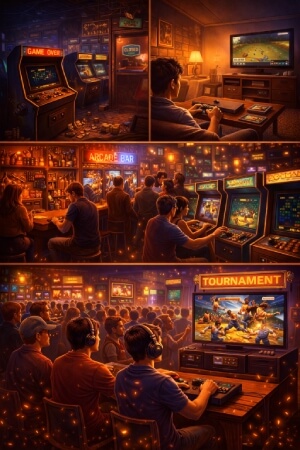
With the advent of home consoles and online gaming, an entirely transformational shift had taken place in arcades. From being something that might otherwise have required a public space for display albeit glorifying the games themselves, they could now be played in the comfort of one's own home thereby putting huge pressure on foot traffic. Inevitably, many arcades either shut down or translated into another sphere of entertainment.
But arcade culture did not go away, it evolved, experiencing new forms and audiences. The underlying social need that drove arcades perpetuated through technology adaptation.
Home Gaming and the Loss of Shared Space
As consoles grew more powerful, the need to visit arcades diminished. Players could practice endlessly at home, reducing the spectacle of public mastery. This altered how gaming communities formed, shifting interaction online.
However, something was lost in the transition. Online spaces offered scale but lacked physical presence. The casual conversations, spontaneous rivalries, and shared silences of arcades became harder to replicate, highlighting the unique value of face-to-face play.
Barcades and Hybrid Venues
In response, new hybrid spaces emerged. Barcades combined classic machines with food and drink, reframing arcades as social nightlife venues rather than youth hangouts. These spaces emphasized nostalgia while updating the social context.
This model reintroduced public play to adults who remembered arcades fondly. It also attracted newcomers curious about the tactile experience of arcade machines. While different from traditional arcades, these venues preserved the communal core that defined arcade culture.
Competitive Events and Community Revival
Tournaments and themed nights became tools for rebuilding community. Organized events provided structure and purpose, drawing players together around shared goals. Even small competitions created energy and visibility.
These gatherings echoed earlier arcade dynamics, emphasizing presence and shared experience. They showed that while daily casual play might decline, concentrated moments of collective engagement could still sustain arcade communities.
What Arcades Taught Us About Community
Arcades gave the lesson of why community thrives around play. They show that communities do not need to be deliberately built, only specialization in focus and repetition of meeting. Coins, screens, and scores are tools, but the goodness comes from them bringing people together.
These lessons continue to be relevant today as digital spaces evolve. Understanding the culture of the arcade goes a long way in explaining why actual people still want to gather when the world is fast becoming virtual.
Accessibility and Low Barriers to Entry
Arcades welcomed players without long-term commitment. A single coin bought entry, and no prior knowledge was required. This openness encouraged experimentation and reduced pressure.
Such accessibility allowed diverse groups to mix. Skill levels varied, but everyone shared the same space. This model contrasts with more exclusive communities that demand time, equipment, or expertise before participation, highlighting why arcades felt approachable and inclusive to many.
Shared Time as a Social Currency
In arcades, time mattered as much as skill. Waiting for a turn, watching a match, or cheering someone through a difficult level all counted as participation. Presence itself became valuable.
This emphasis on shared time fostered patience and attention. Players learned to engage with others’ experiences, not just their own. These habits reinforced community bonds and made arcades feel alive even when one was not actively playing.
The Importance of Physical Gathering
Arcades remind us that physical spaces shape social behavior. Body language, sound, and proximity all influenced how players interacted. These elements created emotional texture that digital spaces struggle to replicate.
Even today, the appeal of arcades often lies in this physicality. The weight of buttons, the glow of screens, and the hum of a room full of people contribute to a sense of belonging rooted in shared environment.
The Lasting Echo of the Arcade
Though the arcade culture no longer holds much sway, it certainly exerts influence. It helped to show how play can anchor the community, taking ordinary machines and turning them into the thread that connected society. The arcade was a place to gather, rather than simply a place to spend time. Consequently, as new shared games evolve, the teachings of the arcade could still be heard and remind us that the noblest of games bring people into each other's presence.